Author: Du Toit McLachlan
The World Rugby Rankings of the 18th and 25th of August 2025 told the story of the previous two weekends’ tumultuous results: the Springboks had been dislodged from their position atop the men’s rankings, replaced by the All Blacks and sliding back to third behind Ireland after a 38-22 loss against the Wallabies at Ellis Park. This was the Springboks’ first loss against the team from Down Under since 2022. A week later, they were back up to second, having narrowly beaten the Wallabies 30-22 in Cape Town, while the All Blacks’ loss to Argentina meant the gap between the two shrank to just 0.72 points. The margins of victory, coupled with home ground advantage, meant the World Champions dropped three points for the loss and only gained 0.23 points for the win, while New Zealand gained just 0.45 points for the win but dropped 1.73 points for the loss. The fight for World Number one will continue to rage throughout the Rugby Championship, while Argentina and Australia battle to breach the top five.
History of the World Rugby rankings
The top of the World Rugby Rankings is an exclusive club, and South Africa will be desperate to regain the crown they have worn consistently since winning the 2019 World Cup. Only six teams have been ranked number one in the World since 2003, when the official World Rugby rankings were first introduced. New Zealand held it for a total of 759 weeks, followed by South Africa at 284, Ireland at 74, England at 36, Wales at two, and France with one week as the highest-ranked team in the World. New Zealand’s dominance during the 2010s is reflected in their number one ranking for 509 consecutive weeks, from 16 November 2009 until 12 August 2019, when Wales dethroned them. In keeping with their relative decline and the greater strength of South Africa, France and Ireland, the All Blacks have only returned to World number one 11 times since then, out of a total of 314 weeks, and last week’s ascent to the top of the tree means they reclaim a crown they last wore on 8 November 2021.
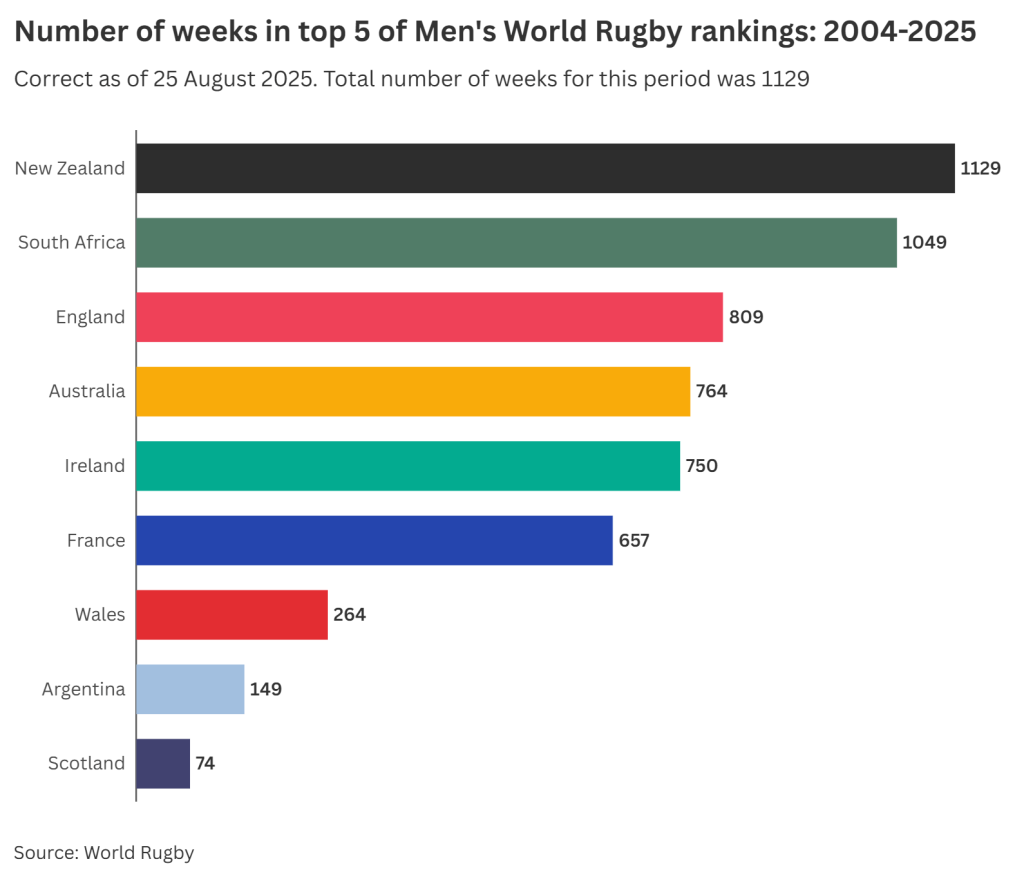
The stratification of the World Rugby rankings goes beyond the top spot: only seven teams have ever been ranked 2nd in the World, eight teams have been ranked 3rd or 4th, and nine have been ranked 5th, due to New Zealand briefly occupying the spot for two weeks in August 2022. In fact, only 14 teams have appeared in the top 10 since 2004. Outside of the teams playing in the Six Nations and Rugby Championship, only Fiji, Samoa, Tonga, and Japan have risen to 10th or above. The way the ranking points are calculated aims to reward an upset handsomely, but the lack of breakthrough by the smaller teams stems from a lack of access and matches against the higher-ranked teams, a situation which will get worse, not better, in the coming years. When they do get the occasional chance, the underdogs rarely take it.
How does the World Rugby Rankings work?
How the rankings are calculated means New Zealand was unlikely to be dislodged from top spot this last week. World Rugby employs a points-exchange system, meaning whatever World Ranking points one team gains, the other loses. The formula handicaps the higher-ranked and home team, as an away win results in greater points gained for the travelling team than a win for the home side would, and the higher-ranked team always stands to gain fewer points for a win than the underdog. The margin of victory also plays a role, with winning margins of greater than 15 points giving teams higher points. Importantly, points earned during a World Cup are doubled, which explains South Africa’s recent runs as the World number one following successive wins in 2019 and 2023.
The effect of the last fortnight’s Rugby Championship results on the rankings reflects the advantage away sides enjoy and how upsets, especially big ones, are handsomely rewarded. South Africa losing by 16 points while playing at Ellis Park meant they dropped three points, their largest drop since 21 September 2015, when they dropped four points after losing against Argentina 25-37 in Durban. The gap of 2.73 points between the Springboks and New Zealand meant that they could have only reclaimed top spot this past week if Argentina had beaten New Zealand by more than 15 points and they had won in Cape Town. The opportunity to return to World Number one beckons for the Boks, as they now travel to New Zealand for two away tests. Their ranking is second, and playing away means a win or draw in Auckland or Wellington would help them leapfrog New Zealand back into the top spot. Similarly, Argentina stands to gain handsomely from a successful tour to Australia, as their victory over the All Blacks means they are within striking distance of the Wallabies and can overtake them with a win in Queensland.
Stories outside of the World Rankings Mainstream
Looking a bit further afield, outside the bubble of the Rugby Championship and the battle for the top spot, the rankings offer an interesting view on rugby and reveal several interesting subplots and trajectories developing in the game. Of course, the most high-profile of these is the tale of the Welsh, who during this World Cup cycle have slipped from 8th to 12th, briefly reaching their lowest ever ranking of 14th in July 2025. Other 2023 World Cup contestants who have slid down the rankings have been Portugal, dropping from 13th to 18th and Namibia, which has dropped six places from 21st to 27th. Georgia and Australia have both gained three places, with the former moving up from 14th to 11th, their highest ranking to date, and Australia moving from 9th to 6th, their highest ranking since the 30th of January 2023.
As a brief but important aside, the men from Tbilisi represent a case study of the uneven access teams below the elite level have to have high-quality opposition and chances to improve their position in the world rankings. They are the highest-ranked team in the Rugby Europe Championship, the second tier of rugby competition in Europe, meaning matches played against the likes of the Netherlands, Switzerland, and even Romania present minimal opportunity to gain ranking points, and, more importantly, chances to really improve and continue making progress. For example, their closest competitor in this year’s Championship was Spain, ranked seven places below them when they played in mid-February. Conversely, the higher-ranked opposition they faced this year, Ireland and South Africa, didn’t represent realistic targets for gaining points either. To move up the rankings and breach the top 10, they must naturally play and regularly beat those around them in the rankings, the likes of Samoa, Wales, Italy and Fiji.
The new Rugby Nations Championship, slated to start in 2026, will do the opposite and hamper their access, as the Six Nations and Rugby Championship teams, along with Japan and Fiji, will now compete amongst themselves during the two international windows in July and November. The competition will have two divisions, with those playing in the second tier not yet announced, but presumably featuring the Georgians as the tier’s highest-ranked team. It will only be played every two years. However, promotion to the top tier will only commence from 2030, and since the World Cup is in 2027, their chance to play against the top-tier teams and earn higher ranking points will only really come in 2029.
Notwithstanding this growing divide and the challenges teams face just below the top tier, some good news stories emerge when you dive much deeper into the rankings. One nation in particular catches the eye: Algeria, which has risen 32 positions since the 2023 World Cup. Algeria first entered the rankings on 7 June 2021 in 92nd place, after being given full World Rugby member status in May of the same year. This marked the culmination of a concerted push towards member status since 2015, when the Algerian Ministry of Sport sanctioned the creation of a rugby federation in the country. They gained full member status with Rugby Africa in December 2016 and associate status with World Rugby in 2019, before gaining full member status in 2021. The team members of that initial squad in 2021 mostly plied their trade in France, and were very experienced players, as only two of the 45-member squad were aged below 25 years at the time. The national team had also progressed steadily from the lower levels of the Rugby Africa Cup, winning the third-tier tournament in 2017 and the second-tier tournament a year later in 2018.
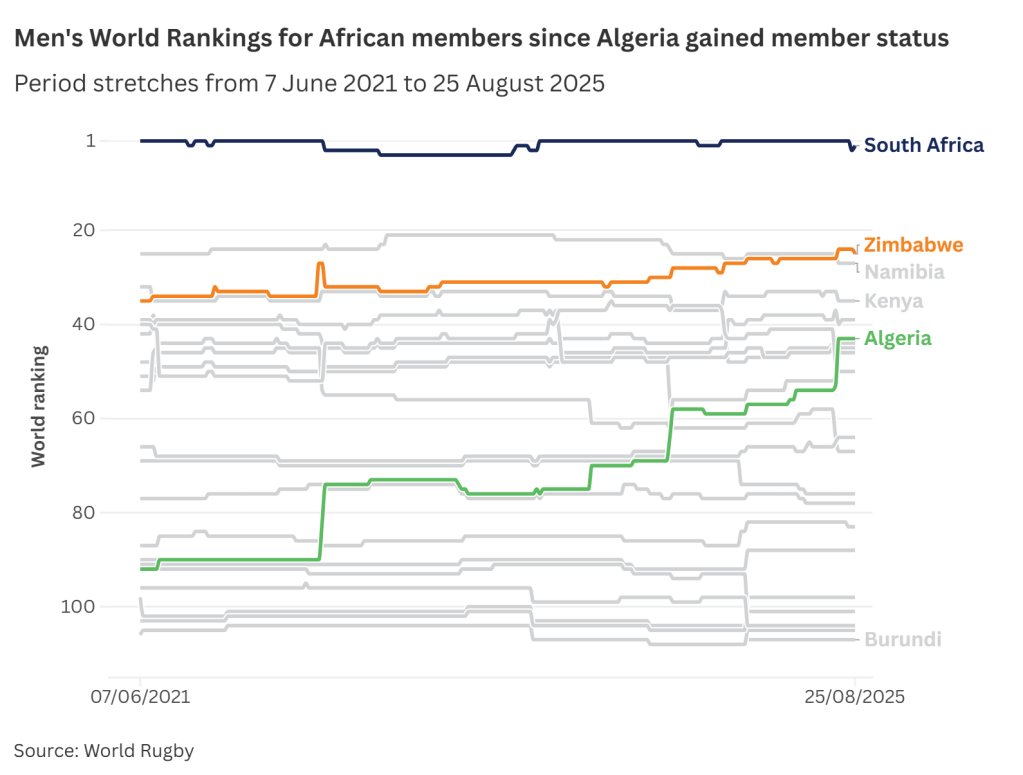
Their first victory as a full World Rugby member came just over a month after entering the rankings as they beat Uganda 22-16 on 18 July 2021, despite the team from Kampala being ranked 51 places above them. Since then, Algeria has gone from strength to strength: they finished third in the Rugby Africa Cup in 2022, second in 2024 and third again in 2025, losing to Namibia 21-7 before defeating two-time champions Kenya in the third-place play-off. Their current ranking of 43rd, obtained on the 21st of July 2025 after they triumphed over the Kenyans, places them sixth in Africa out of 21 teams. Despite missing out on the 2027 edition of the World Cup, the team from North Africa will undoubtedly be targeting a 2031 berth in the USA, as the expansion to 24 teams from 2027 onwards means the winner of the Rugby Africa Cup qualifies directly for the global showpiece event.
Three other nations also stand out for the progress they have made since entering the rankings: the UAE, which has climbed 56 places since joining the rankings on 3 December 2012, ranking 40th in the latest rankings; Mexico, which has reached 37th position this year, up 34 places since joining the ranking on the 19th of March 2012; and Columbia, who have reached the heights of 32nd before and have gained 35 places since rankings began in October 2003. None of these teams has qualified for a World Cup, with the UAE’s Africa/Asia playoff defeat against Namibia by 86 points to 29 on the 26th of July 2025, the closest any of them has come.
The intrigue of World Rankings is often found in the depths
Although the battle for top spot will continue to garner the most attention amongst rugby fans, with the All Blacks and Springboks set to trade places over the next few weeks, the stories written in the basement of the 113 team rankings are often more intriguing. Algeria, the UAE, Zimbabwe, and Spain have made great strides in their own right over the last couple of years, and their future trajectories will certainly be ones to keep an eye on. The key for these and others, such as Georgia, to keep growing and climbing the rankings is regular rugby against those ranked just above and below them. If growing the sport globally remains their top priority, those governing the game must look out for the smaller nations, such as Mexico, and get them to play more regularly; the men from Mexico have only played two games this year, beating Jamaica and Trinidad and Tobago. World Rugby will be well served to ensure all nations have equal access to competitive fixtures throughout the rugby calendar, not just those competing for top honours.
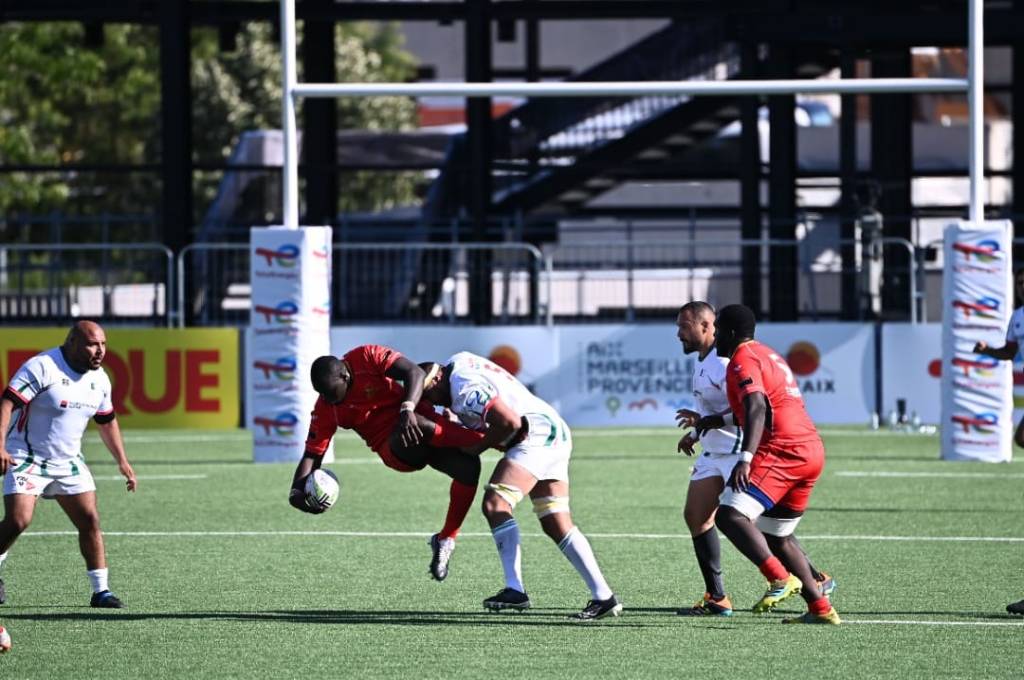
Image: Algerian Rugby Federation


 The Rugby Historian
Leave a reply to Rugby Rankings Watch – 13 and 14 September 2025 – The Rugby Historian Cancel reply