The changing scene
In the last 12 months, four rugby players have achieved the special distinction of eclipsing their country’s long-standing caps record.
The first of them was James Slipper, who, during the 2024 edition of the Rugby Championship, broke the Australian cap record of 139 Test caps established by George Gregan on 6 October 2007. Next, it was the turn of Eben Etzebeth to better the cap record of his former Springbok lock partner, Victor Matfield, who had, since 30 October 2015, held the South African cap record of 127 Test matches. Later that year, on 30 November 2024, Cian Healy became the new Irish cap record holder when he broke Brian O’Driscoll’s record of 133 Test matches for Ireland. Interestingly, O’Driscoll is still the Irish player who has played the most Test matches, having played in 8 Test matches for the British and Irish Lions. When Healy retired from Test rugby at the end of the 2025 Six Nations Championship, he was still 4 Test matches shy of O’Driscoll’s record of 141 Test matches played.
Finally, Pablo Matera very recently bettered the Argentina cap record of 110 caps, which was established by Agustin Creevy on 31 August 2024, when he played in his 111th Test for Argentina on 12 July 2025.
Fittingly, the extraordinary achievements of the four new record holders were greeted with great acclaim by their supporters and the press. However, a healthy dose of historical context is needed to fully appreciate their accomplishments while giving due credit to those who held the mantle before them.
Without trying to diminish these players’ remarkable achievements, there are many factors that must be taken into account when weighing up their achievements against those who had previously held their country’s cap records since the Second World War.
The key factor to keep in mind is the amount of rugby played in the years following the Second World War. The number of Tests played by the 10 countries which are today regarded as the Tier One rugby-playing nations has been steadily increasing since 1945. The following graph shows the increase in the average number of Tests played per year in five-year periods, starting from 1945:
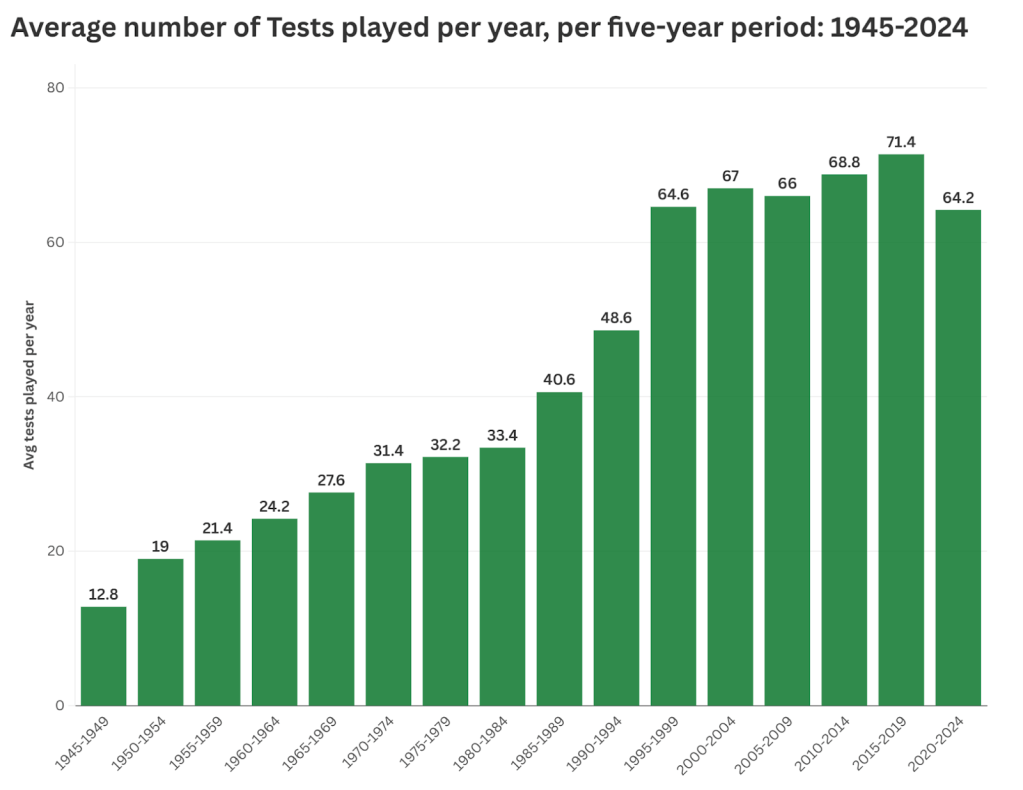
As can be clearly seen from the graph, the sharp upturn in the average number of Tests played started in 1995. From 1990 to 1994, an average of 48.6 Tests were played per year, while from 1995 to 1999, an average of 64.6 Tests were played per year. This followed a steady climb from 1980 onward, with the dawn of the professional era in the 1990s driving a boom in the number of Test rugby matches played.
A look back at past greats
To fully understand the greatness of the achievements of the cap record holders of the past, one must consider them against the background of the number of tests played before the Rugby World Cup and the professional era. This is especially true of the players who held this record for South Africa in the years from 1949 to 1997. The country’s tumultuous political landscape meant it was excluded from Test rugby between 1984 and 1992, leading to the Springboks missing the first two World Cups and a generation of players only playing a handful of Tests over eight years of isolation. These unique circumstances heavily influenced how the baton of record cap holder was passed on for the Springboks, and deserve a closer look. In this blog, we focus on the seven Springboks who, from 1956 to 1997, were the proud individual holders of the record number of Tests played for South Africa and their path to gaining that honour.
Salty du Rand
When South Africa played their first Test in the post-World War II era on 16 July 1949, none of the players had ever played in a Test match before. The fact that no Springbok who played before the Second World War ever played in a Test again meant that a time of new records and achievements lay before the debutants in this and subsequent Tests.
The man holding the record in 1949, with 18 Test matches, was M M Louw, better known as “Boy” Louw, one of the giants of Springbok rugby. From his debut on 18 August 1928 in the third Test against the All Blacks to his last Test on 10 September 1938, Boy Louw only missed one Test, against the All Blacks in 1937, due to an injury. A C Parker, in his book The Giants of South African Rugby, says the following about Louw:
“But the great thing about M. M. Louw was that he had the football brain to match his brawn; that he was no mere dreadnought. Terrific at all phases of tight forward play- scrummaging, line-out work and rucking- he was also fairly mobile and active in the open, being able to handle like a three-quarter.“
On the eve of the Springboks’ tour to Australia and New Zealand in 1956, there were two players poised to better Boy Louw’s Springbok cap record. Chris Koch and Salty du Rand both made their debut in the second Test against New Zealand in 1949, and from then on up to the fourth Test against the British and Irish Lions in 1955, they each had missed only one of the Test matches that the Springboks had played. Therefore, they each had 15 Tests to their credit when the 1955 series against the Lions ended. However, as things turned out, the time had not yet arrived for Koch to become the joint Test cap record holder for the Springboks.
While Koch was injured before the second Test against Australia and could not regain his place for the first Test against New Zealand, Du Rand featured in every Test played on the tour and captained the Springboks in his record-equalling 18th Test.
The Springboks’ 8-3 second Test victory was not only a personal milestone for Du Rand but proved to be the high point of the tour for the Springboks. A C Parker remarks in The Springboks 1891 to 1970 that the try scored by Du Rand to ensure victory for the Springboks crowned a great personal display by him. However, not everything went his way on this momentous day since he had to leave the field before the end of the match with a gash to his head.
Du Rand also played the remaining two Tests of the 1956 series, establishing a new Test cap record of 21 Tests. He retired from international rugby at the end of the tour at the relatively young age of 30. After missing the fourth Test against New Zealand in 1949, Du Rand had played lock for the Springboks in 19 consecutive Test matches, which also made him the record holder for having played the most consecutive Test matches for the Springboks.
Chris Koch
In a career that lasted almost 11 years, Chris Koch had the rare distinction of playing in seven Tests against the All Blacks, across three series from 1949 to 1960. Having missed out to Salty du Rand in 1956, he had to wait for the 1960 Test series against the All Blacks to establish a new Test cap record for the Springboks.
Koch was a very mobile prop forward who scored five tries in his career and was part of the famous 44-0 Springbok victory against Scotland in 1951, scoring two tries in the match. His tally of five tries as a prop was a long-standing record that was eventually equalled by Os du Randt, who scored his five tries in 80 Tests. Gürthro Steenkamp, whose career ended in 2014, currently holds the record for tries scored by a prop, having scored six in 53 Tests.
The first Test against the All Blacks in 1960 was a fitting occasion for Koch to celebrate his achievement of equalling Du Rand’s record of 21 Tests. AC Parker remarks that South African rugby supporters were gloomy about the prospects of a Springbok victory against the All Blacks, since the Springboks did not convince in their warm-up Test match against Scotland, and the All Blacks had not lost a match on tour leading up to the first Test. They had also beaten the highly rated Northern Transvaal team 27-3 on the Saturday before the Test. However, the 13-0 Springbok victory was their biggest against the All Blacks since 1928 when the Springboks won 17-0 in Durban. In commenting on the match, AC Parker remarked that he could not recall a finer performance by a Springbok side in any international match that he had covered.
Unfortunately, Koch’s record-breaking 22nd Test was not a happy occasion for the Springboks, who lost the second Test against the All Blacks in Cape Town 3-11. Koch’s own performance was also not up to par, and the press was unanimous in their comments that he had probably reached the end of his illustrious Springbok career.
Johan Claassen
Great players that Du Rand and Koch were, their achievements are overshadowed by the third post-war record cap holder, Johan Claassen. His career, which started with the first Test against the British and Irish Lions in 1955, stretched over eight seasons to end against the same opponents in 1962. In this period, he only missed the fourth Test against the All Blacks in 1960 through injury. AC Parker described him as one of the finest Springbok lock forwards of all time, while in Springbok Saga, Chris Greyvenstein mentions that during the 1956 Springbok tour, Claassen was praised as being the finest lock forward that had ever visited New Zealand.
Claassen also captained the Springboks in nine Tests. He first captained the Springboks in 1958 against France when he was just short of his 29th birthday. Although his first experience of captaincy did not meet with success, when he again took up the reins against Ireland in 1961, the Springboks won handsomely, and Claassen was retained as captain for the two-Test series against Australia.
Claassen’s resumption of the captaincy duties for the Springboks coincided with him equalling Koch’s record of 22 Tests. In 1961, the Springboks had regained their standing as one of the leading rugby nations in the world, having beaten the All Blacks in 1960 and going undefeated in the Test matches on their tour to the British Isles and France in 1960-61. In the three home Tests played by the Springboks in 1961, their reputation was enhanced by convincing victories in the once-off Test against Ireland and two Tests against Australia.
The match report of the Test against Ireland in the Sunday Times of 14 May 1961 commented on Claassen’s inspiring leadership in the 24-8 victory and remarked that his towering frame was always in the van of the Springboks’ attacks. In Claassen’s record-breaking 23rd Test match, the Springboks reached even greater heights by scoring eight tries in their 28-3 victory against the Wallabies. In Springbok Saga, Greyvenstein remarks that in this Test, the Springboks gave an exhilarating performance of sound but uninhibited rugby. Interestingly, Claassen assumed the kicking duties in this Test but could only convert two of the eight tries that were scored.
In 1962, Avril Malan, who had captained the Springboks in the last two Tests against the All Blacks in 1960 and on their successful tour to the Northern hemisphere in 1960-61, returned to fitness after missing the whole of the 1961 domestic season. However, Claassen’s leadership of the Springboks in 1961 had impressed the Springbok selectors enough to retain him as captain for the series against the British and Irish Lions. The Springboks won the Test series against the Lions by three Tests to none, with one match drawn. In the fourth Test, Claassen established the new Springbok Test cap record of 28 Tests, and the Springboks celebrated this achievement by winning the Test by a record margin of 20 points.
John Gainsford
In a previous blog about Scotland’s tour to South Africa in 1960, we referred to the rather inauspicious start to John Gainsford’s Test career against Scotland. However, any doubts about Gainsford’s outstanding talents were soon dispelled; already in 1962, he was hailed as the greatest centre three-quarter in the world. John Gainsford is another Springbok Test cap record holder who only missed one Test match through injury in his career.
Gainsford reached the milestone of equalling Johan Claassen’s Test cap record of 28 matches in the second Test against New Zealand during the disastrous tour to Australia and New Zealand in 1965. In keeping with the tour as a whole, this match was a particular low point in the Springboks’ history. Not only was it the seventh successive Test match lost by the Springboks, their worst run of form ever, the 0-13 loss was also the biggest defeat ever suffered against New Zealand. Incidentally, this unwanted record was broken again when the All Blacks defeated the Springboks 20-3 in the fourth Test of the same series.
Despite the gloomy mood of the tour up until that point, the third test was to bring great joy for both Gainsford and his Springbok teammates. There is no doubt that Gainsford’s achievement of breaking Johan Claassen’s Test cap record was overshadowed by what is regarded as one of the most remarkable Springbok victories ever. However, Gainsford’s performance in this Test was also a high point in his career. A former All Black, Charlie Saxton, commented that in this Test, Gainsford played like the world’s best midfield back.
He scored the Springboks’ first try, but that effort seemed to have been in vain when the Springboks were trailing by 11 points at half-time. The story of the Springboks’ greatest fight back in a Test match has been told many times, and for the purposes of this blog, it is only necessary to mention that Gainsford added a second try to his first-half effort, helping South Africa win 19-16. This was the first time and only time that Gainsford scored two tries in a Test. With these tries, Gainsford also broke Ferdie Bergh’s long-standing record of most Test tries for South Africa, which had stood at seven since 1937. Gainsford’s record of eight Test tries was equalled by Jannie Engelbrecht in 1969, but was only broken by Gerrie Germishuys on 8 November 1980.
The fact that the Springboks did not play any Test matches in 1966 meant that Gainsford was only able to add four more Tests to his tally of 29 Tests. In an interview with Peter Bills, published in The Independent of 7 July 2009, Gainsford related that the pressures of running his own business meant that after the 1965 tour to Australia and New Zealand he virtually stopped training, although he was still playing for and captaining Western Province in 1967. Therefore, he admits that he was totally unfit and did not deserve to be selected for the three Test matches he played against France in 1967.
Jannie Engelbrecht
Born in the same year, 1938, Jannie Engelbrecht and John Gainsford’s Springbok careers were closely intertwined until Gainsford’s retirement in 1967. Even before their debut Test match against Scotland in 1960, they were both selected to tour with the Junior Springboks to Argentina in 1959 and played together in the second match against Argentina on that tour. However, after their debut Test, Engelbrecht was not initially selected for the series against the All Blacks, although he was only prevented from playing in the fourth Test, after eventually being selected, due to a bout of tonsillitis. The pattern of losing his place through loss of form or injury continued through the early part of Engelbrecht’s career. Consequently, by 1965, Engelbrecht had played in only 15 Tests in contrast to the 22 Tests played by Gainsford in the same period.
Fast-forward four years, and Engelbrecht, now an established and vastly experienced Springbok, would see his record-equalling 33rd Test against the Wallabies marked by controversy, which continued after the match had concluded. AC Parker reveals in The Springboks 1891 to 1970 that Engelbrecht had been suffering from a groin injury prior to this match and had to receive a pain-killing injection before the Test. Apparently, not everybody in the Springbok camp was happy with this and would have preferred if he had been stood down before the Test. Notwithstanding the handicap he had to contend with in the second Test, Engelbrecht succeeded in scoring two tries, thus equalling Gainsford’s record of 8 Test tries in his career.
Although the Springboks comfortably won the match 16-9, their performance did not impress the critics. Notwithstanding the two tries scored by Engelbrecht in the Test, the consensus in the press was that Engelbrecht had reached the end of his long and distinguished career. To add to Engelbrecht’s woes, both his club, Stellenbosch University, and the Western Province left him out of their teams in the period after the second Test. Voices were raised in the press that Engelbrecht was being rested or “molly-coddeled” while his Springbok colleague Eben Olivier, who played for the same teams, was not afforded such an opportunity. Regret was expressed that Engelbrecht, if selected for the third Test, would break John Gainsford’s Test cap record and would be in a position to also break Gainsford’s Test try record. Marshall Wilson, commenting on the Springbok team selected for the third Test in the Rand Daily Mail of 1 September 1969, also remarked that the choice of Gert Muller over Engelbrecht had been long overdue.
It is a pity that Engelbrecht, whom Chris Greyvenstein, writing in 1992, described as a wing whose likes had not been seen since his retirement, had to end his Springbok career in these circumstances. These events raise the question of whether a player who had clearly reached the end of his career should keep on playing purely in pursuit of a team record.
Frik du Preez
Frik du Preez, presently the oldest living Springbok and the Springbok player of the 20th century, inducted into World Rugby’s Hall of Fame in 2009 and described by Chris Greyvenstein as a living legend, held the Springbok Test cap record from 12 June 1971 until 19 July 1997 when James Small appeared as a replacement in his 39th Test. Taking into account that Du Preez played the greatest part of his career in a period when there were no reserves or tactical substitutions during Test matches, there is an argument to be made that Du Preez’s record was only broken when Small started his 39th Test on 8 November 1997.
Du Preez’s Springbok career began when he was selected as a loose forward to tour with the 1960-61 Springboks to the Northern Hemisphere. He played his first test as flanker against England on 7 January 1961 and his last Test on 7 August 1971 against the Wallabies. He played seven Test matches as a flanker and 31 as a lock, a record for a Springbok lock which was also only broken in 1997 by Mark Andrews. Du Preez equalled the record of 33 Test matches in the epic final Test match of the 1970 Test series against the All Blacks and bettered the record in the first Test against France in 1971.
Although the names of the players who have been the Springbok Test cap record holders since the Second World War may have been forgotten over time, the same is not true of Frik du Preez. He stands alone, with numerous photographs of Du Preez’s flying tackle on Chris Laidlaw during the 1970 Test series against the All Blacks and his tremendous run to score his only Test try against the 1968 Lions still appearing in many posts on social media and in the press.
Jan Ellis
In a career spanning 12 years from 1965 to 1976, Jan Ellis played in 38 Test matches for the Springboks. What is most extraordinary about his career is that in the 10 years from his first cap in the first Test against New Zealand in 1965 to the second Test against France in 1974, he only missed one Test, a match against England in 1969. That makes his career, at least insofar as it concerns Test caps, even more impressive than that of Du Preez. Whereas Ellis played in 38 of the 41 Springbok Tests played during the period concerned, Du Preez played in 38 of the 51 Tests played in the period from his debut to his retirement in 1971. Ellis’ record as the most capped Springbok flanker was only broken by Andre Venter on 4 November 1999.
Unfortunately, it appears that Ellis, like Engelbrecht, just hung on too long in an attempt to equal and surpass Du Preez’s record of 38 Springbok Test matches. Having missed the Test series in 1975 against France on home ground due to injury, Ellis returned for the first Test match against the All Blacks in 1976. Although the Springboks won the Test, it was apparent that Ellis was well past his best, and there was little surprise when he was replaced by Theuns Stofberg for the second Test, leaving Ellis tied with Du Preez on 38 Tests.
The new era
On 26 June 1994, Philippe Sella of France became the first rugby union Test player to surpass the 100 Test match mark. Since then, 78 players from the 10 Tier One nations have reached and surpassed this mark. When Agustin Creevy became the first Argentinian to reach the 100 Test match mark on 5 August 2023, all 10 Tier One nations’ record Test Cap holders had 100 or more Test caps to their names.
These achievements have been made possible by the fundamental changes that were introduced into rugby union during the professional era, which began in 1995. Factors like the enormous increase in Test matches played in a season and the introduction of tactical substitutions have made it much easier for the outstanding players of this era to accumulate a number of Test matches which were absolutely unattainable for the great players of gone by. eras.
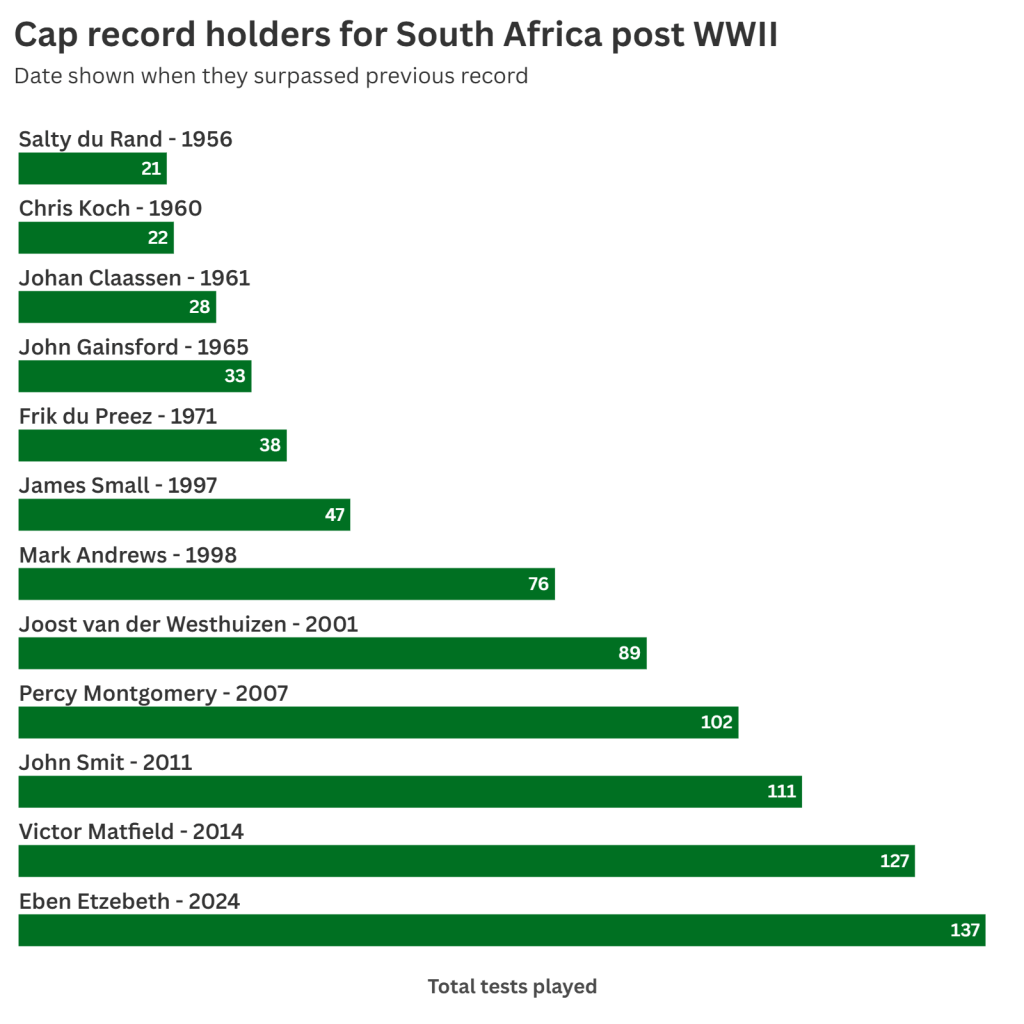
In the case of South Africa then the achievements of Salty du Rand, Chris Koch, Johan Claassen, John Gainsford, Jannie Engelbrecht, Frik du Preez and Jan Ellis must be viewed in the same light as the great achievements of their successors James Small (47 Tests), Mark Andrews (77), Joost van der Westhuizen (89), Percy Montgomery (102), John Smit (111), Victor Matfield (127) and Eben Etzebeth (136). The record of most Tests played for South Africa will continue to climb as the years roll by, but the feats achieved by those in the amateur era of the game should always be remembered and celebrated in the years to come.

 The Rugby Historian
Leave a comment