
Author: Du Toit McLachlan
Everyone loves an underdog, so the saying goes. Rugby’s history is marked by stories of the plucky and brave team besting their more fancied and well-resourced opponent, securing an unlikely win and creating history for their nation. Think Romania in 1990, recording their first victory over France in France. Think Western Samoa in 1991, shocking the Welsh in their own backyard. More recently, the mind turns to the amazing scenes in Brighton during the 2015 World Cup, when Japan shocked the Springboks in a thrilling come-from-behind win. Everyone, except the South African supporters, of course, was rooting for the Japanese that day, and the result will live long in the memory for those lucky enough to have witnessed the surreal match.
Defining an underdog and an upset
The rarity of these occasions is at once the source of the great joy we feel when they occur and a shame, given the lack of equality and jeopardy it entails. How we define an “underdog” determines how rare these upsets are, of course. For the sake of drawing a neat line in the sand, we consider an underdog upset victory as follows: when a Tier 1 nation, those currently playing in the Six Nations and Rugby Championship, is beaten by a side outside this select group of 10 countries. To give a more accurate representation, a time period is also imposed, stretching from 2000 to the present, seeing as Italy only joined the top table of European competition that year. Lastly, Argentina are included in this bracket, even though they only joined the Rugby Championship in 2012, as they have competed in every edition of the Rugby World Cup, reached the quarter finals five times and finished third in 2007. Their results against sides outside the top echelon of the game also show the gap in quality.
This convenient but necessary definition does mean we exclude a crucial factor when judging the merits of an underdog story: context. For example, Wales losing to Japan recently to extend their losing streak to 18 matches could hardly be described as an upset; the Welsh victory a week later was probably the real surprise. Nor could the Fijian victory over the Scots in July 2025 be classed as a particularly surprising result, given the recent form of the Pacific Island nation and the lineup the Northern hemisphere put out, lacking their best players touring with the British and Irish Lions. Other examples of these types of results are plentiful, and always deciding who the underdog is in any given match is sometimes based on gut feeling alone, no matter what the World rankings or betting odds say. On the other hand, it is sometimes patently obvious who enters the match as the underdog: Japan in 2015, Tonga beating France at the 2011 World Cup, Fiji besting the Welsh in an epic during the 2007 World Cup.
Cleanly and easily distinguishing between the truly unique underdog upset victories and those more akin to a mild surprise is not, however, the point. Notwithstanding your views on a single game’s upset credentials, the number of times an underdog has caused an upset, as defined above, remains small. There have been 467 matches between the 10 top-tier teams described above and other teams outside that bracket. The so-called “second-tier” teams have only won 38 and drawn three of those Tests, meaning they lost 91% of the games they have played against the big guns of international rugby. Those rare victories have mostly come against Wales, Scotland and especially Italy: the Italians were the opponents in 16 of these upsets, followed by the Welsh and Scottish with 7 tests apiece; that’s 30 of the 38 wins for the underdogs. New Zealand has never suffered such a defeat, while South Africa, Argentina, Ireland and England have only lost once; Australia and France only twice. The All Blacks’ record since 1945 is especially worth noting: only once have they lost to a team not in the game’s top tier, the defeat coming against a World XV side in April 1992, a strong side made up predominantly of players from other top-tier nations.
Fiji, Japan, and the future of underdogs in international rugby
On the other side of the coin, Fiji has been the most adept at beating those at the top of the rugby tree, recording 11 wins and 1 draw against them since 2000. They have also played the most games against the big guns, their 62 matches followed by 60 for Japan, 55 for Samoa and 45 for Canada. The Brave Blossoms of Japan have tasted victory 7 times, drawing once, while Samoa have bested their more storied rivals 9 times. Canada has been much less successful, only beating the top team twice and drawing once, the last such positive result coming against Scotland in 2002. The USA too have struggled to crack the upset code, winning only once in their 38 outings, also beating the Scots back in 2018. Outside of Fiji and Japan, underdog nations have upset the big boys 18 times since 2000, only five of those coming in the last 10 years. Half of the 18 victories have come against Italy, and 9 of them were notched by Samoa, their latest win coming in 2024.
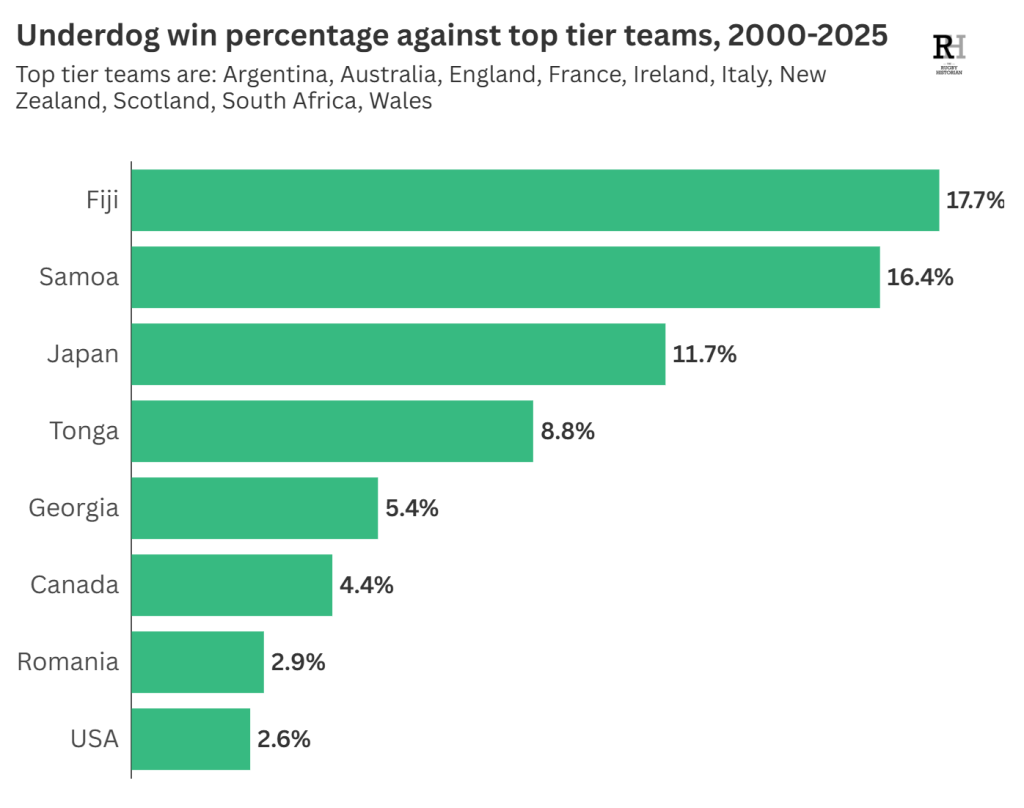
The gap is growing between Fiji and Japan, and the rest of those beneath the top tier of international rugby. Fiji have claimed notable recent scalps, beating both Australia and England in 2023, Wales in 2024 and Scotland in July 2025. The last two and a half years have also seen them come close to further upsets on a few occasions, losing to both Wales and England by 6 points at the 2023 World Cup and by 3 points against Australia in July 2025. Japan has beaten only Wales since 2019, when they beat both Ireland and Scotland in a fairytale run to the World Cup quarter-finals on home soil. They will have another shot at the team from Cardiff in November 2025, playing the Welsh for a third time in a calendar year, whilst also facing the Irish in Dublin and Australia in Tokyo. Fiji face an uphill struggle to add to their growing collection of upsets, as they will face England and France in the Autumn Nations Series later this year. These two teams will likely continue to widen the gap as they will start to play more regularly against the big guns in the newly formed Nations Championship, kicking off in June 2026.
The more teams on the other side of this divide, nations like Georgia, Samoa and Tonga, consistently challenge and beat the big boys, the better for everyone who loves the sport. The worry is that these teams’ records against those they are more likely to beat, the lower-ranked teams in the top tier, such as Scotland, Argentina, Wales and Italy, are poor. Outside of Fiji and Japan, there have been 184 games between smaller rugby nations and these lower-ranked top-tier teams since 2000; the underdogs won only 17 of these games, equivalent to 9%. In contrast, Fiji and Japan won or drew 24% of their games against these four teams in that period. Tonga and Samoa have the chance to improve this record, playing Scotland and Italy later this year, respectively.
Rugby needs more upsets
The history of rugby is marked by and enhanced by the tales of underdogs defying the odds and besting those sitting at the top table of the game. Although it enhances how special these games are, the rarity of these upsets reflects a reality where the top tier is rarely troubled by teams other than Fiji and Japan. The sooner this reality changes, the better, as the game will boost its popularity in countries where rugby is beginning to grow in stature and serve to bring the game to new markets.


 The Rugby Historian
Leave a comment