
Author: Du Toit McLachlan
Matches between rugby’s so-called Goliaths, those nations playing in the Six Nations and Rugby Championship tournaments, and the smaller teams, Davids, are set to become an even rarer occurrence from 2026. World Rugby announced in October 2023 that the rugby calendar will be revamped, with a new tournament, the World Rugby Nations Championship, replacing the traditional fixtures played in the June and November international windows. The biennial tournament is meant to add more context and intrigue to the matches played during these periods. Still, the format means crossover matches between rugby’s big guns and the smaller unions will almost solely occur at the World Cup.
As the new Nations Championship consists of two divisions, comprised of the Six Nations, Rugby Championship and two invited unions in one and 12 further teams in the other, the opportunity of smaller unions to test themselves against the best has narrowed considerably. Furthermore, promotion and relegation between the divisions will only kick in by 2030, limiting the chances of those outside the main theatres of rugby to gain recognition and improve their playing standard.
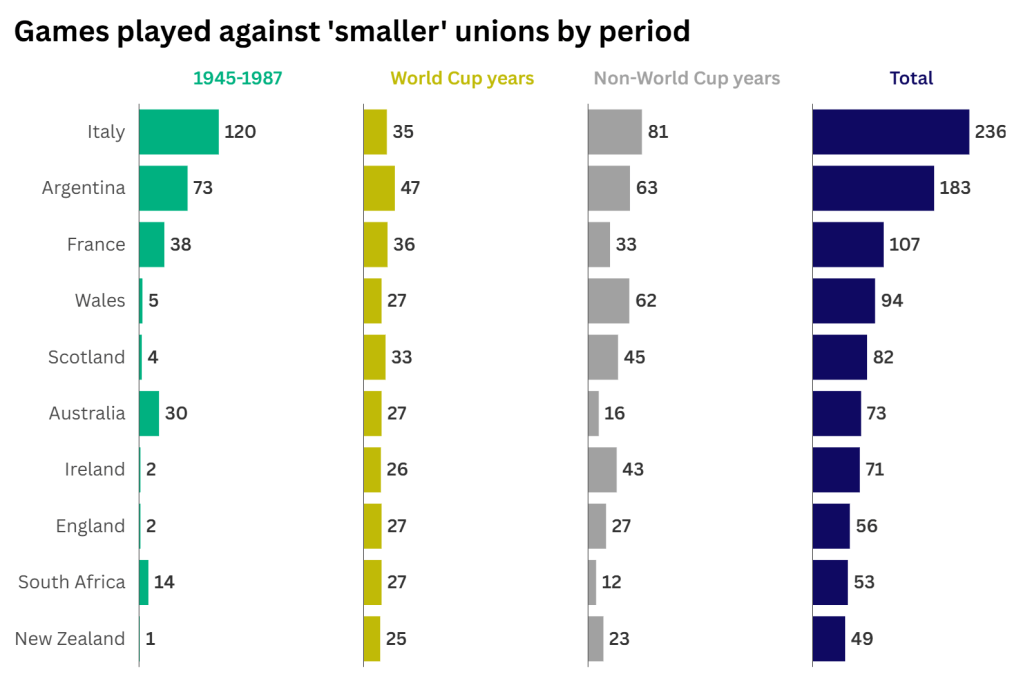
Historically, games played between a smaller union and a bigger one have been rare. In the years following the Second World War, France and Australia were the only major rugby nations that promoted rugby by competing on an equal footing with the smaller rugby nations. From 1952 to 1967, France and Italy played each other annually. France won all these matches, Italy’s best results being in 1962, when they lost by three points in Brescia and 1963, when they lost by only two points in Grenoble. However, in 1965 and 1966, Italy lost both matches 0-21, and a further heavy 13-60 defeat followed this in 1967, leading to France no longer awarding full international status to matches played with Italy until they met again in the Latin Cup 1995.
France and Romania met twice in 1957, Romania giving a good account of themselves in Bucharest, where they lost by only three points. However, they suffered a heavy 0-39 defeat in Bordeaux in December. The fixtures between Romania and France resumed in 1960 with Romania beating France in Bucharest. John Griffiths remarks in The Phoenix Book of International Rugby Records that this victory earned the Romanians a permanent place in subsequent French international fixture arrangements, and the fixture taking place in the autumn served as a trial match for France’s Five Nations commitments. Interestingly, in the four fixtures from 1960 to 1963, France could only manage to draw the two games played in France, losing the matches played in Bucharest. Until 1985, Romania and France played each other on an annual basis.
France also toured Argentina in 1949, 1954 and 1960, playing in seven Test matches and winning all of them. However, after 1960, 14 years went by before France again toured Argentina. France also played in Test matches against Czechoslovakia in 1956 and 1968, and played against Fiji in France in 1964.
Australia also played their part in promoting rugby in its neighbourhood. Fiji toured Australia in 1952 and 1954 and proved to be worthy opponents by sharing the two-Test series. However, in 1961, the Fijians could only draw one of the three Tests played. In the 1960s, Australia’s Test commitments against the established rugby nations increased perceptibly, which meant that it was only in 1972 that the two countries met again. This time Fiji hosted the Australians for the first time, losing the match by a narrow two-point margin.
In the early 1980s, the other established rugby nations gradually started including smaller rugby nations in their official Test match fixture lists. England was the first of the Home Nations to award official Test match status to such matches when they toured Argentina in 1981. In September of the same year, Scotland played their first official Test match against Romania, and New Zealand also played against Romania in the autumn of 1981. Wales and Ireland also played their first official Test matches against Romania in 1983 and 1986, respectively. Wales’ first match against Romania ended in a humiliating 6-24 defeat for Wales. Still in isolation in the 1980s, South Africa tried to counteract their exclusion from the mainstream of international rugby by inviting a team from South America, called the Jaguars, to tour South Africa in 1980. During this tour, the Jaguar Test teams that faced the Springboks were composed entirely of Test players from Argentina and included well-known names like Hugo Porta, Tomas Peterson, Alejandro Iachetti and Enrique Rodriguez.
Since the first Rugby World Cup in 1987, matches between the Goliaths and Davids of the rugby world have become much more commonplace. Over the years, they have produced some noteworthy results and entertaining matches.
A shining example is the four matches Namibia won against more fancied opponents in 1991, when they beat Italy twice in June before also defeating Ireland twice in July. They won the first test 15-6 on July 20, 1991, and repeated the trick a week later, scoring 26 points to the Irish’s 15. The Namibian side of the early 1990s was known for giving top sides a challenging game, coming close to famous victories against the Welsh in 1990, before again acquitting themselves well in 1993 in a one-off test against the men from Cardiff. Runouts against that standard of opposition dried up for the Namibians, however, as the last game they played against top-tier opposition at home was Italy in 2001. Since then, they have played South Africa in Cape Town in 2007, losing 105-13, and only faced the likes of France, New Zealand and Ireland in Rugby World Cups, every four years.
A similar story is that of Romania, which beat Italy in four consecutive meetings between 1987 and 1990, and famously defeated the French 12-6 at Auch in 1990 too. The Oaks followed up that notable win with an 18-12 success against the Scots in Bucharest, their 7th in 16 matches against Five Nations teams and Italy since 1987. From there, political turmoil and financial hardship hit Romanian rugby hard, leading to a dip in their level of play and humbling defeats against the bigger unions, the 70-21 reverse against Wales in 1997 and the 134-0 defeat to England in 2001 charting their course downward. The 62-14 defeat against France in 2006 would be the last fixture played against a top-tier union on home soil until they welcomed Argentina to Bucharest in 2021, a game they narrowly lost 24-17. Italy would also visit a year later, but outside of those two exceptions, the once mighty Oaks have had to be content to face their more illustrious and well-financed opponents at World Cups, with the latest edition in 2023 seeing them beaten by handy margins in all four of their pool games.
Other smaller but prominent unions such as Fiji, Japan, Samoa, Canada, Tonga, Uruguay and the USA have had diverging paths, some seeing their matches increase in the last decade. At the same time, others have also seen their exposure to the highest level of competition decrease over the previous 15 years. Fiji and Japan, which have already played the 2nd and 4th most matches against the top-tier nations since 1987, stand to benefit even further, as they were the two unions invited to join the top division in the new Nations Championship. Since 2011, Japan and Fiji have played against top-tier opponents 43 and 36 times, respectively, with Samoa ranking third at 29, Georgia fourth with 28 games and Tonga fifth at 23 games. Before the World Cup in New Zealand in 2011, from 1987 to the end of 2010, Romania had played the highest number of these games with 70, followed by Canada at 54 and Samoa at 49. Fiji was ranked fourth at 44, and the USA fifth with 41. Japan was a distant sixth with 28 games.
The tide has turned for several of these unions, and as crossover matches between the top-tier and second-tier teams get fewer, it seems unlikely that they will stem the tide. For Fiji and Japan, who already benefit from greater access, the invitation to the top table of rugby is a golden opportunity to distance themselves from the rest of the second-tier chasing pack and cement their place amongst the elite.
Image: rugbyworldcup_/Flickr

 The Rugby Historian
Leave a comment