
Author: Jer McLachlan
A love for rugby is born
It all started with Gerald Bosch. A ten-year-old boy needs a hero and, apart from my dad, Gerald Bosch, the famous Transvaal and Springbok flyhalf of the seventies was mine. When you have a hero, you need to know all about him, so after seeing him play for the first time, I started reading the daily newspapers’ sports pages obsessively to gain as much knowledge of my idol as possible.
The year was 1974, and Willie John McBride’s formidable British and Irish Lions were touring South Africa. The Springboks were already on the back foot, losing the first test 12-3 in Cape Town. Bosch made his Springbok debut in the second test in Pretoria, where the Springboks suffered the biggest defeat in their history up until then, being beaten 28-9. He was one of the ten players left out of the Springbok team for the third test and did not play again in that series.
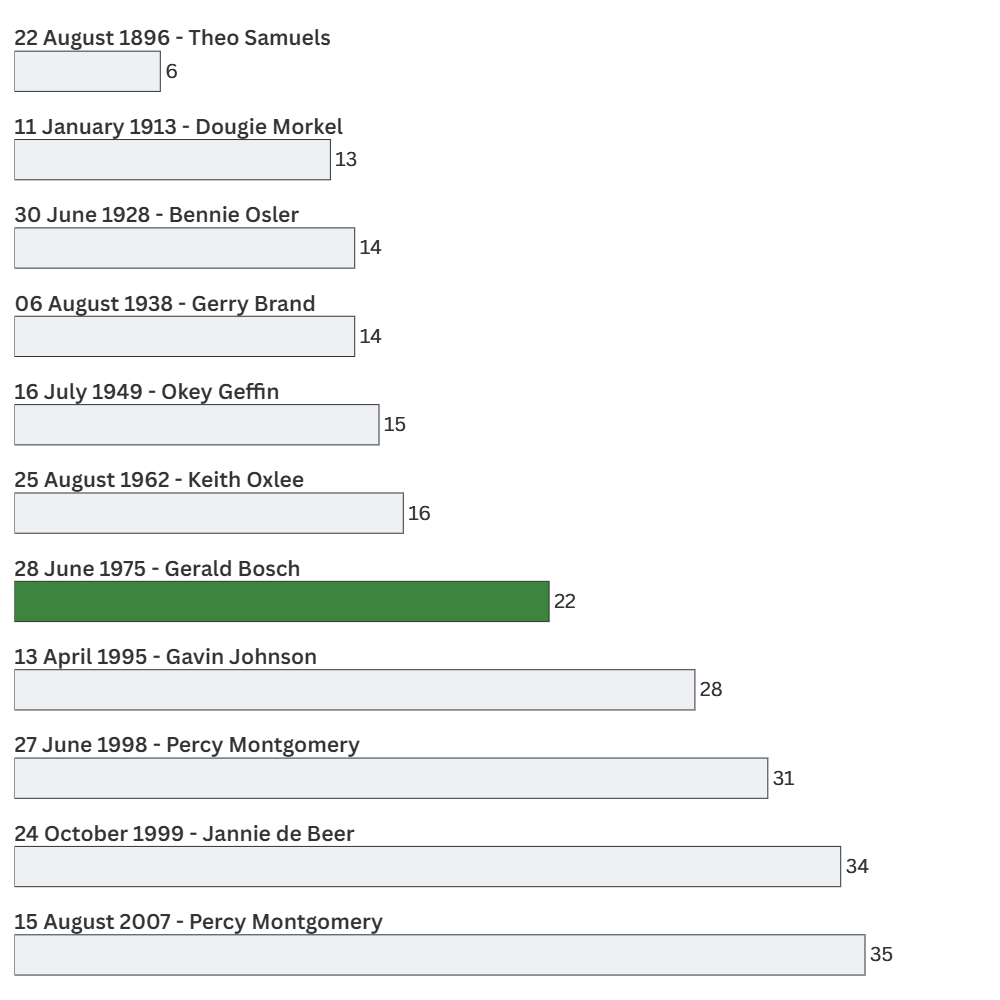
However, to my delight, he was back in the Springbok test team during the end-of-year tour to France and remained the number one Springbok flyhalf for the following eight Springbok tests. Bosch’s Springbok career was, unfortunately, brief and ended with the last test against the All Blacks in 1976. His career stretched over three years, during which he played in nine tests and scored 89 points, which made him the second-highest point scorer for the Springboks at that stage. The 22 points he scored against France in the second test in 1975 were also the highest score by an individual in a test for the Springboks until that point. This record would only be surpassed by Gavin Johnson in April 1995, 20 years later.
Springboks’ highest points in a match since 1896
In 1977 Bosch took part in the first multi-racial trials that took place in South Africa to select a Springbok team to play against a World XV at the inauguration of the new Loftus Versfeld Stadium. However, he was not selected for the Springboks and played for the Junior Springboks against the World Second XV in the curtain raiser to the Springboks’ match. Bosch retired from rugby in 1978 having amassed 892 points in 72 games for Transvaal.
The highlight of 1974 was watching the fourth test against the Lions with my dad at the old Ellis Park, where the Springboks salvaged some pride by restricting the Lions to a 13-all draw. I still remember that test match very well, and even though Bosch was not playing, I soon realised that all these players wearing the green and gold of South Africa were my heroes.
A hobby grows into a fascination
As time passed, I expanded my reading from the newspapers and started a collection of rugby books, which I still have. My first rugby book was the Afrikaans version of Chris Greyvenstein’s Springbok Saga, published in 1977. I bought it for 18 rands with coins I had collected in an old coffee tin over a long period.
Fascinated by the stories in Springbok Saga and able to watch many more rugby matches when television came to South Africa in 1975/76, my knowledge of the history of Springbok rugby grew rapidly. In fact, I am quietly confident that I can still name all the test teams that played for South Africa from 1949 to 1994; matches from 1995 onwards became much too complicated as tactical substitutions were introduced.
Since Gerald Bosch was my childhood hero, I was curious about the other great flyhalves that played for the Springboks. I racked my brain to try and devise a system that I could use to compare the likes of Hannes Brewis, Keith Oxlee, Piet Visagie and even Henry Honiball with Gerald Bosch. After many months spent doing this, I realised that finding criteria that may be applied equally to players from different eras is nearly impossible. The most apparent criterion, namely the number of test matches played, was a non-starter due to the vast difference in the number of tests played in the amateur and professional eras. It became clear that trying to compare players from different eras is futile.
Notwithstanding this realisation, my enthusiasm to gather more information and statistics about rugby and rugby players has never waned. I also became interested to learn more about the opponents that the Springboks had faced over the years. I still remember my excitement when, in the books section of Harrods of London, I came across Men in Black, Chester and McMillan’s excellent book on All Black test match history. The Phoenix Book of International Rugby Records by John Griffiths is another indispensable book that I used in my quest for more information on the other rugby nations. Books like these were invaluable before it was possible to access the Internet and Stuart Farmer’s rugby Statsguru database.
The next chapter
Although we will always be fascinated by the icons of the rugby world, such as Colin Meads, Jack Kyle, Frik du Preez, and many more, I have realised that all these players could not have achieved what they did without the help of their teammates. Logically, it must be accepted that the selectors of the teams chose the best available players in their position. Every player deemed to be best in his position in his country at a particular time deserves to be considered together with the great players of his day. Consequently, I wanted to learn about the players who, in their day, were also indispensable for their teams but whose names had been forgotten.
To this end, I have created a comprehensive database of all the rugby test matches played by the Tier One nations, the British and Irish Lions, and the players who played in them from 1 January 1945 until the present day. The database focuses on the Tier One nations and the British and Irish Lions due in large part to data availability. When I started to compile the database, I chose 1 January 1945 as the starting date. At that stage, I was still considering comparing players from different eras. In my mind, it was only possible to compare players after the Second World War since the game had changed too much from how it was played before the war to make such comparisons.
When I completed the database in December 2024, I wondered what to do with all this information. And so we come to the purpose of this blog and the website. My son, Du Toit, and I believe that there may be many persons from all over the world who have rugby heroes of yesteryears who they believe may have been the best players ever in his position, but also know that there is no way to prove this empirically. Therefore, rather than drawing comparisons, we will be delving into history to tell the stories of players who excelled for their countries and made rugby the sport we love today. We will also spotlight those players whose names have been forgotten but played their part in the story.
Although rugby history will be the main focus of our blog, we also know that new chapters are added to the game’s annals with every new Six Nations Championship, Rugby Championship, and British and Irish Lions tour. We hope to bring a long-term, historical perspective to these current rugby stories by examining them against the backdrop of the competitions and tours preceding them.
Thank you for reading the first blog of the Rugby Historian! We will release a new piece every month. See you then.

 The Rugby Historian
Leave a comment