Author: Du Toit McLachlan
For the last two months, the rugby world has been fixated on the British and Irish Lions, turning its collective mind from an enthralling Six Nations, potentially the best ever, to the selection of a squad on a mission to win only its second series in the last 25 years. Now that the dust has somewhat settled, with Andy Farrell naming an intimidating squad led by the English captain Maro Itoje, attention can begin to shift to their opponents, Australia and what we can expect from the hosts of the Men’s Rugby World Cup in 2027.
The Wallabies are clear underdogs: since 2013, the last time the Lions toured Down Under, Australia has gradually declined, winning fewer and fewer games, and slipping to their lowest world ranking of 9th in 2023. The team, currently coached by Joe Schmidt, has not won the Rugby Championship since 2015, finishing last in the previous two editions of the competition, with points tallies of one in 2023 and five in 2024. On the plus side, they have finished in second place four times since 2015, and also recorded their highest ever points tally in the competition of 18 in 2021. Despite these relative successes, Australia’s results in post-2013 have been disappointing: in those 11 years, from 2014 to 2024, Australia has finished the year with a win percentage of 40% or lower six times. Last year was the first time since 1973 that the Wallabies have had a win percentage below 50% for three consecutive years. Their win percentage was 20% or lower between 1971 and 1973, but they only played 5 or 6 games a year back then.
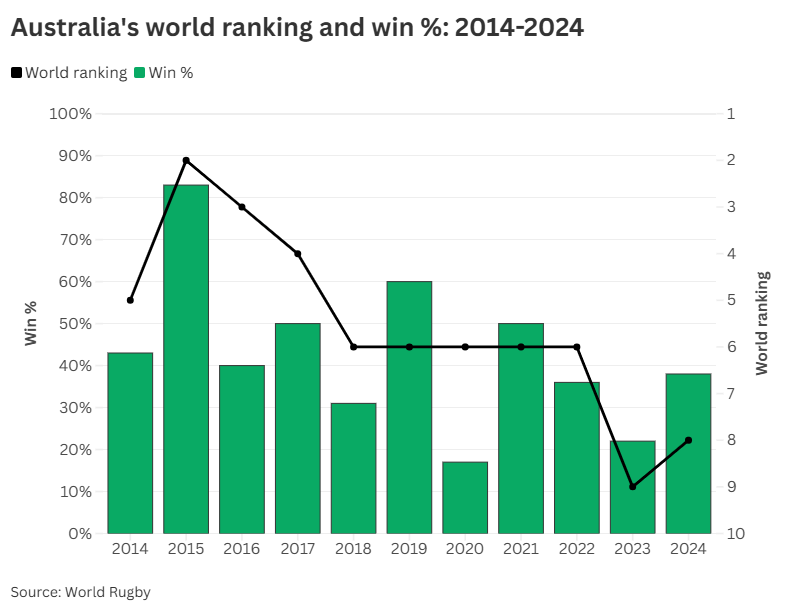
Their world ranking reflects the downward trend in form: since that 2015 win in the Rugby Championship, when they finished the year ranked second behind the All Blacks, Australia’s ranking has fallen to 8th at the end of 2024, reaching a record low of 9th in 2023. On top of all that, Australia bowed out of the World Cup at the group stage for the first time ever in 2023, recording their worst ever defeat against Wales, 40-6, in the process. By that stage, Australian rugby had reached a new low, and the resignation of Eddie Jones in October 2023 marked the end of a disastrous year, the nadir for a team sliding further and further into disrepair.
The appointment of Joe Schmidt in January 2024 heralded a new dawn for rugby in Australia, and performances have picked up considerably in the short time he has been in charge. Last year, the Wallabies won six of their 13 matches and only lost by three points against New Zealand and Ireland. The year was interspersed with poor performances too, not least against Argentina in September, when they lost 67-27, their biggest Test match loss ever. Even so, Schmidt has revived a team bereft of confidence and ensured the upcoming Lions tour is a much more interesting prospect than it was in late 2023. The fact that he is set to relinquish his role in July 2026 is however a potential setback for the Wallabies in the medium term. For the upcoming Lions tour, injuries to key players Joseph-Aukuso Suaalii and Noah Lolesio have dampened the mood, with doubts remaining if either will be fit enough to face Fiji on 6 July, the Wallabies’ only warm-up Test before facing the Lions.
Australia can ill afford to lose any players, least of all those who have some previous experience playing on the international stage, like Lolesio. The Wallabies’ current first-choice fly-half only has 29 Test caps, but in a very inexperienced squad, this makes him the 13th most capped player out of 40. In fact, of the 40 players chosen by Schmidt for a three-day camp in Sydney at the start of 2025, 19 have played 10 Tests or less. In sharp contrast, only one player in the Lions’ 38-man squad, Henry Pollock, has played less than 10 Tests, with 18 playing 50 or more. Australia’s players are also much younger, with the average age of the Australian squad being 25.9 years, compared to 28.6 for the Lions’, and only four players being aged over 30, compared to 16 for the touring side.

Experience is not everything, but as in 2013, when the average number of caps for Lions was 37.9 and 25.4 for Australia, the Wallabies will be up against a side packed with players much more used to the rigours and pressure of Test rugby. It remains to be seen how big a factor this will be as the tour unfolds, but, coupled with their up-and-down recent form and injuries to key players, Australia will have a mountain to climb to stop this Lions squad from repeating the feat they accomplished back in 2013.

 The Rugby Historian
Leave a comment